
Clinically Documented & Authored by: Dr. Ranjani Rao, MDS Principal Dentist & Consultant Implantologist Fellowship in Orthodontics — ICNOG, Italy Fellowship & Mastership in Implantology — ICOI Certification in Aesthetic Dentistry — Ronald Goldstein, USA Double Gold Medalist, Bangalore University 25+ Years of Clinical Experience V2 E-City Dental Center, Electronic City, Bengaluru
Case documented with full patient consent. Patient identity withheld for privacy. Reviewed and approved for publication: April 2026
Patient Profile
| Detail | Information |
|---|---|
| Age | 22 years |
| Gender | Male |
| Country of Residence | Canada (international student) |
| Chief Complaint | Missing upper front tooth following accident-related trauma |
| Tooth Involved | Upper central incisor |
| Treating Clinician | Dr. Ranjani Rao, MDS, FICOI |
| Clinic | V2 E-City Dental Center, Bengaluru, India |
| Visit 1 | Extraction, bone grafting, temporary restoration |
| Visit 2 | Implant placement + permanent crown — completed in a single appointment |
Background — When an Accident Changes Everything
Dental trauma in young adults is more common than most people realise. For this 22-year-old student living and studying in Canada, a road accident caused severe damage to his upper front teeth — the most visible, confidence-defining teeth in the mouth.
While one tooth remained functional, the other deteriorated progressively over two years. By the time he returned to Bangalore on his annual vacation, the compromised tooth had deteriorated beyond the point of restoration.
The clinical and personal challenge was significant:
- The tooth could not be saved
- He was living abroad with very limited time to spend in India
- He could not afford to make multiple trips across two separate years for a conventional two-stage implant protocol
- The missing front tooth was affecting his confidence and daily life
What followed is a story of careful planning, advanced clinical decision-making, and technology working together to deliver a complete restoration — across two annual visits, with the entire second-stage treatment completed in a single day.
Visit 1 — Extraction, Infection Management & Bone Grafting
On his first visit to V2 E-City Dental Center, Dr. Ranjani Rao conducted a thorough clinical and radiographic assessment. The findings confirmed that the traumatised tooth was non-restorable and required extraction.
Critically, the extraction socket showed signs of infection — a known complication when a structurally compromised tooth is left in place for an extended period. Managing this infection before implant placement was essential to ensure long-term implant success.
Treatment completed in Visit 1:
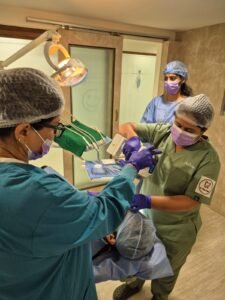
1. Atraumatic Extraction The tooth was carefully extracted using a minimally traumatic technique to preserve as much surrounding bone and soft tissue as possible.
2. Socket Debridement The socket was thoroughly cleaned and debrided to eliminate all infected tissue and create a clean biological environment.
3. Bone Grafting (Socket Preservation) Synthetic bone graft material (artificial bone) was carefully packed into the extraction socket. This is a well-established procedure in implant dentistry — socket preservation grafting maintains bone volume at the extraction site, prevents the natural bone resorption that occurs after tooth loss, and creates an optimal foundation for future implant placement.
This step was particularly critical for this patient. Without the bone graft, significant bone volume loss would have occurred over the following year, potentially making implant placement more complex or requiring additional bone augmentation procedures at the time of implant surgery.
4. Temporary Restoration A provisional tooth was placed to restore appearance and function during the healing period — ensuring the patient did not have to return to Canada with a visible gap in his front teeth.
He returned to Canada. Over the following year, the bone graft integrated and matured. The site healed completely.
The Science Behind Bone Grafting for Socket Preservation
Socket preservation grafting at the time of extraction is supported by extensive clinical evidence. When a tooth is lost, the surrounding alveolar bone begins to resorb naturally — studies show that up to 40–60% of bone volume can be lost within the first year following extraction without intervention.
By placing a bone graft immediately at extraction, clinicians can significantly reduce this bone loss, preserving the architecture needed for successful implant placement. This is precisely what made the same-day implant and crown procedure possible during Visit 2 — the bone was well-preserved, well-healed, and of sufficient volume and density to support immediate loading.
Visit 2 — Implant Placement, Digital Scanning & Permanent Crown — All in One Day
One year later, the patient returned to Bangalore. The healed implant site was assessed clinically and radiographically. The bone quality and volume were excellent — a direct result of the socket preservation graft placed the previous year.
Now came the decision that makes this case clinically significant.
Why Standard Protocol Would Not Work for This Patient
In conventional implant dentistry, treatment follows a two-stage protocol:
Stage 1 — Place the implant → Allow 3–6 months for osseointegration (bone fusion) Stage 2 — Attach the permanent crown
For most patients, this is entirely appropriate. But for a student based in Canada — who could only travel to India once a year — waiting 6 months between stages was simply not possible without significant disruption to his academic life and additional international travel costs.
Why Immediate Loading Was Clinically Appropriate
The decision to proceed with immediate loading — placing the permanent crown on the same day as the implant — was made based on rigorous clinical assessment, not convenience alone.
The clinical success of immediate loading is highly dependent on multiple factors: patient selection, bone quality and quantity, implant design, implant primary stability, occlusal loading, and the clinician’s surgical ability — with implant primary stability being the most important determinant of success. PubMed Central
In this patient’s case, all the critical criteria for immediate loading were met:
- ✅ Excellent bone quality and volume — confirmed by X-ray and clinical assessment, attributed to the prior bone graft
- ✅ No active infection — the site was fully healed and infection-free
- ✅ Sufficient primary stability — the implant achieved the torque values required for immediate loading
- ✅ Favourable occlusion — bite forces on the front tooth were within acceptable limits for immediate loading
- ✅ Young, healthy patient — optimal healing capacity
- ✅ Digital scanning capability — enabling same-day crown fabrication with precision
A prospective randomised clinical trial comparing immediate and delayed loading protocols for single anterior maxillary implants found that both protocols demonstrated comparable clinical and radiographic outcomes over 12 months — with immediate loading offering superior early patient satisfaction without compromising implant success. PubMed Central
The Procedure — Step by Step
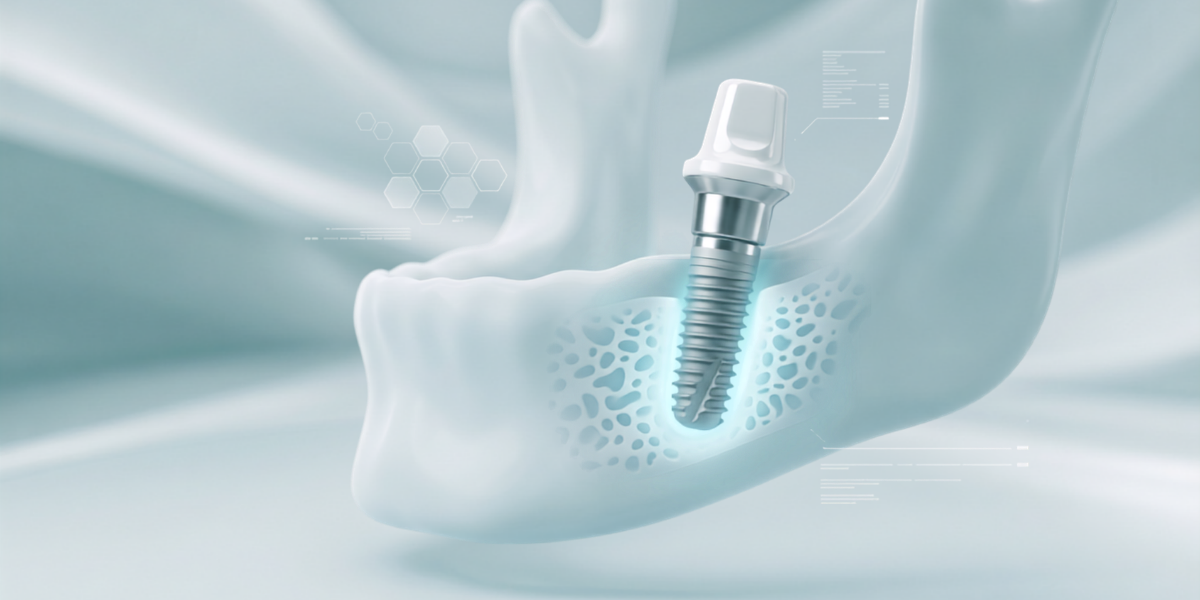
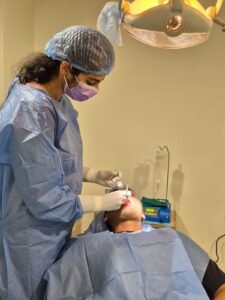
Step 1 — Implant Placement The titanium implant fixture was surgically placed into the healed bone site with precision. The post-placement X-ray confirms ideal positioning — the implant is perfectly seated within the bone, in correct angulation and depth, with healthy bone visible on all sides.
Step 2 — Primary Stability Verification Following placement, implant primary stability was verified — confirming the implant had achieved sufficient engagement with the bone to support immediate loading without risk of micromovement during the osseointegration period.
Step 3 — Digital Scanning An intraoral digital scan was taken immediately after implant placement. This eliminated the need for traditional impression materials and allowed the crown to be fabricated with exceptional accuracy and fit.
Step 4 — Permanent Crown Fabrication & Fitting The permanent crown was fabricated using digital data from the scan and fitted on the same day — restoring the upper front tooth completely in terms of function, appearance, and bite.
The patient who arrived with a gap in his smile left the clinic with a complete, natural-looking front tooth — the same day.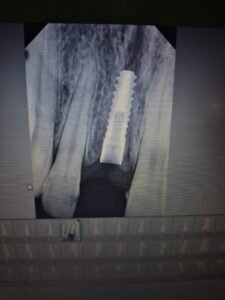
Clinical Evidence — What the Research Says
This case aligns with a growing and robust body of clinical evidence supporting immediate loading in appropriately selected patients:
On Success Rates: Over the past 30 years, numerous long-term studies with patient follow-ups ranging from 5 to 10 years consistently report implant survival rates of 97% to 100% for immediate loading — indicating that new teeth are highly likely to integrate successfully without rejection. 3StepSmiles
On Patient Selection: Studies on immediate loading implants show that successful outcomes can be expected when the critical criteria are fulfilled — including adequate bone quality, sufficient primary stability, and appropriate clinician surgical expertise. PubMed Central
On Comparable Outcomes to Conventional Loading: Clinical research consistently demonstrates that immediate load dental implants achieve success rates comparable to traditional staged approaches when performed by experienced practitioners using appropriate protocols — with long-term studies showing properly planned and executed immediate load implants maintain their stability and function for decades with appropriate care. Sunrisedentalimplantcenter
On the Role of the Clinician: Immediate loading is not a technique that can be performed by every dentist. It demands an implantologist with advanced surgical training, deep understanding of bone biology, the ability to assess primary stability intraoperatively, and access to digital technology for same-day crown fabrication. This is precisely the level of expertise that Dr. Ranjani Rao — with her Fellowship & Mastership in Implantology from the International Congress of Oral Implantologists (ICOI) and 25+ years of clinical experience — brings to every case.
How Much Expertise Does This Require?
This is a question patients and referring clinicians rightly ask — and it deserves an honest answer.
Same-day implant and crown treatment is not a routine procedure. It sits at the advanced end of implant dentistry and requires:
1. Fellowship-level Implantology Training The clinician must be able to assess bone density intraoperatively, achieve precise primary stability, and make real-time decisions about loading suitability. This requires formal post-graduate implantology training — not just general dental experience.
2. Advanced Digital Technology Same-day crown fabrication requires intraoral digital scanning and access to a high-precision dental laboratory capable of fabricating a crown rapidly without compromising fit or aesthetics. V2 E-City Dental Center’s partnership with Asia’s largest dental laboratory makes this possible.
3. Rigorous Patient Selection Not every patient is a candidate for immediate loading. Cases involving active infection, insufficient bone volume, poor primary stability, or unfavourable bite forces are not appropriate for this technique. The clinical assessment that determines eligibility is itself a highly skilled process.
4. Comprehensive Treatment Planning
In this case, the success of the same-day procedure in Visit 2 was directly dependent on the quality of the bone graft placed in Visit 1 — a full year earlier. The entire two-visit outcome was planned from the very first appointment. This kind of long-range, patient-specific planning is the hallmark of experienced implantology practice.
Post-Treatment Follow-Up:
One of the most common concerns international patients have is this: “What happens if something goes wrong after I fly home?”
For this patient, Dr. Ranjani Rao’s answer was refreshingly straightforward.
“Most of the treatment is completed right here at the clinic. He is in Bangalore for one week — so any follow-up checks, adjustments, and post-operative review are all done within that window before he flies back to Canada. After that, it is essentially zero maintenance in between. There is no need for check-ups or follow-ups while he is abroad. He simply goes back to his life. The next time we see him will be after one year — at that point we will take an X-ray to confirm the implant is integrating well, and do a cleaning if required.”
— Dr. Ranjani Rao, MDS, FICOI
A Word from Dr. Ranjani Rao
“When this young man first came to us, the challenge was not purely clinical — it was also deeply personal and logistical. He is a student living in Canada. He cannot take six months between appointments. Our responsibility as clinicians is not just to follow a protocol by default, but to find the best, safest, and most appropriate solution for each individual patient.
The bone graft we placed during his first visit gave us the foundation we needed. By the time he returned a year later, the bone was in excellent condition — well-healed, well-preserved, and of sufficient quality to support immediate loading. We placed the implant, took a digital scan, fabricated the crown, and fitted it — all in the same appointment. He left with his smile restored completely.
This is what thoughtful planning, advanced technology, and the right clinical expertise can achieve. Every patient deserves a solution designed around their life — not just their anatomy.”
— Dr. Ranjani Rao, MDS, FICOI Principal Dentist & Consultant Implantologist V2 E-City Dental Center, Bengaluru
Key Clinical Takeaways
For patients living abroad or with limited travel time: With careful planning across two visits, it is entirely possible to complete complex implant treatment during annual trips home — without compromising clinical outcomes or quality.
For young patients with dental trauma: Early intervention — specifically socket preservation bone grafting at the time of extraction — dramatically improves the long-term outcome of future implant placement. Do not delay extraction of a non-restorable tooth.
For patients considering dental tourism: This case demonstrates that Bangalore’s leading clinics are not simply cost-effective alternatives to Western dental care. They are staffed by fellowship-trained implantologists using internationally validated protocols and digital technology — delivering outcomes that meet and exceed global standards.
Clinical References
- Assessment of Immediate versus Delayed Loading Protocols in Single Tooth Anterior Implants — PubMed Central (PMC). Available at: https://pmc.ncbi.nlm.nih.gov/articles/PMC12788490/
- Immediate Loading Implants: Review of the Critical Aspects — PMC, Frontiers in Physiology. Available at: https://pmc.ncbi.nlm.nih.gov/articles/PMC5965071/
- Clinical Outcomes of Immediate Implant Placement — 3–5 Year Follow-Up — BMC Oral Health. Available at: https://bmcoralhealth.biomedcentral.com/articles/10.1186/s12903-024-04058-3
- Differences in Dental Implant Survival Between Immediate vs. Delayed Placement: A Systematic Review and Meta-Analysis — PMC. Available at: https://pmc.ncbi.nlm.nih.gov/articles/PMC10528222/
- International Congress of Oral Implantologists (ICOI) — Pisa Consensus Conference on Implant Success Criteria. Available at: https://www.icoi.org
About the Author
Dr. Ranjani Rao, MDS Principal Dentist & Consultant Implantologist V2 E-City Dental Center, Electronic City, Bengaluru
Dr. Ranjani Rao is a double gold medalist from Bangalore University and one of South India’s most experienced implantologists, with over 25 years of active clinical practice. She holds a Fellowship in Orthodontics from ICNOG Italy, a Fellowship and Mastership in Implantology from the International Congress of Oral Implantologists (ICOI), and a Certification in Aesthetic Dentistry from Ronald Goldstein USA — one of the world’s foremost authorities in cosmetic dentistry.
As co-founder of V2 E-City Dental Center, Dr. Rao has been instrumental in bringing internationally validated clinical protocols, digital dentistry technology, and a patient-first philosophy to Bengaluru. She has pioneered electronic health records in Indian dentistry and co-developed India’s first dental insurance product.
Her clinical interests include implant dentistry, smile design, and complex cosmetic rehabilitation. She is an active member of the International Congress of Oral Implantologists and a passionate advocate for evidence-based dental practice.
👉 Read more about Dr. Ranjani Rao: ecitydental.com/our-story
Are You in a Similar Situation?
If you are living abroad — in Canada, the UK, the US, or Africa — and have been putting off dental treatment because of time, cost, or travel constraints, this case is proof that it can be done efficiently, safely, and to the highest clinical standard.
At V2 E-City Dental Center, we regularly treat international and NRI patients whose treatment is planned around their travel schedules. We offer free virtual pre-consultations — so your diagnosis and treatment plan are ready before you even land in Bangalore.
Frequently Asked Questions
Q: Can a dental implant and crown really be done in one day?
Yes — in carefully selected patients. When bone quality and volume are sufficient and the implant achieves adequate primary stability, immediate loading allows the permanent crown to be fitted on the same day as implant placement. This technique is known as immediate loading and is supported by long-term clinical studies reporting success rates of 97–100%. However it is not suitable for every patient — a thorough clinical assessment is essential before proceeding.
Q: Is same-day dental implant treatment safe?
Yes, when performed by a fellowship-trained implantologist in appropriately selected patients. Clinical success depends on several factors — bone quality and volume, implant primary stability, the patient’s general health, and critically, the surgeon’s expertise and experience. At V2 E-City Dental Center, same-day implant treatment is performed exclusively by Dr. Ranjani Rao — a Fellowship and Mastership holder from the International Congress of Oral Implantologists (ICOI) with over 25 years of active clinical practice in implant dentistry.
Q: What follow-up is needed after a same-day implant if I live abroad?
Very minimal — and this is one of the biggest advantages of this treatment for international patients. All post-operative checks, adjustments, and reviews are completed within the patient’s one-week visit to Bangalore before flying home. After returning abroad, zero maintenance is required in between visits. There are no mid-year check-ups, no emergency trips, and no disruption to life abroad. The next scheduled appointment is after one year — at which point we take an X-ray to confirm the implant is integrating well with the bone, and carry out a cleaning if required.
Q: Can NRI or international patients get dental implants in Bangalore?
Absolutely. V2 E-City Dental Center regularly treats NRI and international patients from Canada, the UK, the US, and across Africa. Treatment is planned entirely around the patient’s travel schedule. We offer free virtual pre-consultations before you travel — so your diagnosis, treatment plan, and cost estimate are all confirmed before you even land in Bangalore. Complex implant cases like this one can be efficiently completed across two annual visits home.
Q: How long does a same-day dental implant last?
When correctly placed and well maintained, dental implants can last a lifetime. Long-term clinical studies spanning over 25 years consistently show that properly planned and executed immediate loading implants maintain their stability and function for decades — with appropriate oral hygiene and annual check-ups. The key to longevity is the quality of the initial placement, the bone foundation, and the expertise of the treating implantologist.
Q: What is the difference between a same-day implant and a traditional implant?
A traditional implant protocol involves two separate stages — the implant is placed first, followed by a healing period of 3 to 6 months before the permanent crown is attached. A same-day implant — also called immediate loading — places the implant and fits the permanent crown in a single appointment. Both approaches achieve excellent long-term outcomes when correctly planned. The same-day approach is particularly valuable for international patients and NRIs who cannot make multiple trips over several months.
Q: How do I know if I am a suitable candidate for a same-day implant?
The best way is a thorough clinical consultation — ideally with an X-ray or CBCT scan to assess bone volume and density. Key factors that determine suitability include sufficient bone volume at the implant site, absence of active infection, good general health, and favourable bite forces on the front teeth. At V2 E-City Dental Center, we offer free virtual consultations for international patients — you can share your X-rays and photos with Dr. Ranjani Rao before travelling, and receive a detailed assessment and treatment plan in advance.
Related Reading: